Thoth
Ancient Egyptian god of wisdom, writing, and the Moon.

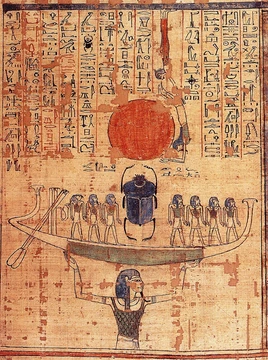
Thoth is an ancient Egyptian deity associated with the Moon, wisdom, knowledge, writing, hieroglyphs, science, magic, art, and judgment. He was often depicted as a man with the head of an ibis or a baboon, animals sacred to him. His chief temple was located in the city of Hermopolis (Khemenu), though it was mostly destroyed before the Christian era. Thoth played vital roles in Egyptian mythology, including maintaining the universe, standing beside Ra's solar barque, arbitrating godly disputes, and judging the dead.
- field
- Egyptian mythology, writing, wisdom, magic
- nationality
- Ancient Egyptian
- cult_center
- Hermopolis (Khemenu)
Lore & Background
Thoth's Egyptian name, ḏḥwty, may be reconstructed as *ḏiḥautī, and is thought to mean 'He who is like the ibis.' He was also known by many titles and aspects, including the Moon god Iah-Djehuty. In art, Thoth was usually depicted with the head of an ibis, sometimes wearing a lunar disk and crescent, or as a baboon. He is often shown holding an ankh, the symbol of life. Thoth served as scribe of the gods and was credited with the invention of writing, music, and hieroglyphs. In the underworld, he appeared as an ape named Aani, who reported when the scales weighing the deceased's heart were exactly even. The Egyptians regarded Thoth as self-begotten and self-produced, master of physical and moral law, and author of all works of science, religion, philosophy, and magic. In the Osiris myth, Thoth gave Isis the words to restore her husband, allowing the conception of Horus.
Reader's Guide
Thoth's significance in ancient Egyptian culture was profound. As a Moon god, his cycles organized much of Egyptian society's rituals and events. He gradually became seen as a god of wisdom, magic, and the measurement of time, serving as secretary and counselor to the Sun god Ra. Thoth was universally worshipped by Egyptian scribes, who often kept his image in their workspaces. During the Late Period, a cult of Thoth gained prominence when his cult center, Khmun (Hermopolis Magna), became the capital; millions of ibis were mummified and buried in his honor. The Greeks identified Thoth with their god Hermes due to similar attributes, eventually combining them as Hermes Trismegistus ('Thrice great'). Thoth appears in Plato's dialogue Phaedrus, where he presents writing to King Thamus, who warns it will lead to forgetfulness. The Egyptian Jew Artapanus of Alexandria euhemerized Thoth-Hermes as a historical figure and claimed he was the same person as Moses. Thoth's legacy endures as a symbol of wisdom, writing, and cosmic order.
Did You Know?
- Thoth's name in Egyptian, ḏḥwty, may mean 'He who is like the ibis.'
- The Greeks identified Thoth with Hermes, leading to the combined figure Hermes Trismegistus.
- Millions of mummified ibises were buried in honor of Thoth during the Late Period.
Name, Symbolism, and Iconography
Thoth's Egyptian name, ḏḥwty, carries a meaning rooted in the sacred ibis. According to the scholar Theodor Hopfner, the root ḏḥw was the oldest known term for that bird, and the suffix -ty signals possession of its qualities, yielding the interpretation "He who is like the ibis." This etymology is echoed in his most recognizable artistic form: a human body crowned by the head of a green ibis, often topped with a lunar disk perched on a crescent moon, marking him as the reckoner of seasons and time. When the artist wished to convey his role as A'an, the god of equilibrium, Thoth instead appeared with the face of a baboon. He could also wear the Atef crown or the double crown of Upper and Lower Egypt, and was frequently shown clutching an ankh, the emblem of life. Beyond these primary forms, he bore numerous titles—A, Sheps, Lord of Khemennu, Asten, Khenti, Mehi, Hab, and A'an—each highlighting a different facet of his vast divine portfolio. His feminine counterpart was Seshat, while Ma'at held the role of his wife.
Mythological Functions and the Osiris Cycle
In the Egyptian mythic tradition, Thoth occupied a central position as the scribe of the gods, credited with originating writing, music, and the hieroglyphic system. The ancient Egyptians regarded him as self-begotten and self-produced, a singular One who mastered both physical law and divine moral order through proper use of Ma'at. He was said to have performed the calculations establishing the heavens, the stars, the Earth, and all that fills them, and was considered the author of every work in science, religion, philosophy, and magic. In the underworld of Duat, Thoth assumed the form of the ape Aani, the god of equilibrium, whose duty was to report the moment when the scales—weighing the deceased's heart against the feather of Ma'at—settled into perfect balance. His role in the Osiris myth is pivotal. Thoth supplied Isis with the words to restore her husband, enabling the couple to conceive Horus, and after the conflict between Horus and Set, he stepped forward to offer counsel and wisdom.
The Temple at Hermopolis and Its Demise
Thoth's chief temple stood in the city of Hermopolis, known in Ancient Egyptian as Khemenu and later called el-Ashmunein in Egyptian Arabic. This sacred complex served as the primary center of worship for the deity of wisdom and writing. Tragically, the temple was mostly destroyed before the dawn of the Christian era, leaving only fragments of its former grandeur. However, by the mid-nineteenth century, this last surviving structure was demolished and its stone was repurposed as fill for the foundation of a sugar factory. The practical demands of industry thus erased the final physical trace of one of Egypt's most important religious sites. The temple's location in Hermopolis underscores how deeply Thoth's worship was woven into the urban and spiritual fabric of ancient Egypt, even as the material evidence of that devotion was ultimately consumed by the changing needs of the modern world.
Cross-Cultural Legacy and the Hermes Connection
The Greek world encountered Thoth and saw in him a mirror of their own god Hermes. The two figures shared so many overlapping attributes—wisdom, writing, magic, and the arbitration of divine disputes—that the Greeks drew a direct parallel between them. One of Thoth's Egyptian titles, "Thrice great," was rendered into Greek as trismégistos, producing the composite name Hermes Trismegistus. The Greeks went further than mere identification. They declared Thoth the inventor of an extraordinary range of disciplines: astronomy, astrology, the science of numbers, mathematics, geometry, surveying, medicine, botany, theology, civilized government, the alphabet, reading, writing, and oratory. In their telling, he was the true author of every work in every branch of knowledge, both human and divine. The name itself traveled through multiple linguistic layers. From the Egyptian ḏḥwty, it passed through Coptic forms such as Thoout, Thōth, Thoot, Thaut, and Thōout, and into Greek as Thōth or Theut. Older scholarly transcriptions offer yet more variants—Jehuti, Tahuti, Tehuti, Zehuti, Techu, and Tetu—each a window into how different cultures attempted to capture the sound and meaning of this ancient name.
Common Misconceptions (Editorial)
Some people believe Thoth was only a god of writing and wisdom, but he was also associated with the Moon, science, magic, art, and judgment. Another common error is thinking his sacred animals were only the ibis, when in fact baboons were also considered sacred to him.
Why It Matters (Editorial)
Thoth endures as a symbol of the ancient drive to systematize knowledge, from writing to law to magic. His lasting appeal reflects a human need to see intellect and order as divine forces that can arbitrate chaos and even judge the dead.
Frequently Asked Questions
What does Thoth look like in Egyptian art?
He is most commonly shown as a human figure with the head of an ibis, though he also appears with a baboon's head in some depictions. Both animals were considered sacred to him and symbolized his connection to the Moon and the cosmos.
What role does Thoth play in the judgment of the dead?
Thoth acts as the divine scribe who records the verdicts during the weighing of the heart ceremony in the afterlife. He keeps track of the cosmic order and ensures that each soul's fate is documented according to Ma'at.
Where was Thoth's main temple located?
His primary cult center was the city of Hermopolis, known in Egyptian as Khemenu. The temple complex there was largely destroyed before the Christian era, so very little of the original structure survives today.
Spotted an error? Know more?
This is a living reference — every entry is fact-audited, and reader corrections feed straight into our audit queue. Suggest an edit · See this site's audit record