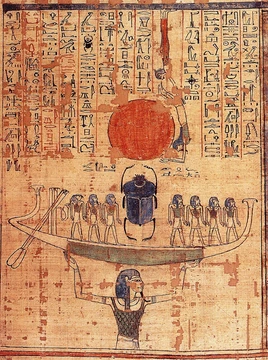
Horus
Ancient Egyptian falcon god of kingship, sky, and protection.

Horus, also known as Heru, Har, Her, or Hor in Ancient Egyptian, is one of the most significant ancient Egyptian deities, serving many functions most notably as the god of kingship, healing, protection, the sun, and the sky. He was worshipped from at least the late prehistoric Egypt until the Ptolemaic Kingdom and Roman Egypt. Different forms of Horus are recorded in history, treated as distinct gods by Egyptologists, though these may be complementary manifestations of the same multi-layered deity. He was most often depicted as a falcon, likely a lanner or peregrine falcon, or as a man with a falcon head.
- field
- Ancient Egyptian deity
- known_for
- God of kingship, healing, protection, the sun, and the sky; associated with the pharaoh
- nationality
- Egyptian
- symbol
- Falcon, Eye of Horus
Lore & Background
The earliest recorded form of Horus is the tutelary deity of Nekhen in Upper Egypt, the first known national god, related to the ruling pharaoh who was regarded as a manifestation of Horus in life and Osiris in death. The most commonly encountered family relationship describes Horus as the son of Isis and Osiris, playing a key role in the Osiris myth as Osiris's heir and rival to Set. In another tradition, Hathor is regarded as his mother and sometimes as his wife. Practicing interpretatio romana, Claudius Aelianus wrote that Egyptians called the god Apollo 'Horus' in their own language, though Plutarch specified that the Horus equated with Apollo was 'Horus the Elder', a primordial form.
Reader's Guide
Horus was central to Egyptian kingship, with the pharaoh identified directly with Horus as a protector and as the son of Ra, ruling and regulating nature as the pharaoh ruled society. The Pyramid Texts describe the pharaoh as Horus in life and Osiris in death, with new incarnations of Horus succeeding the deceased pharaoh. The Eye of Horus, an ancient Egyptian symbol of protection and royal power, was used on funerary amulets and on the bows of ships for safe travel. The conflict between Horus and Set, detailed in The Contendings of Horus and Seth, ultimately resulted in Horus becoming king of Egypt after a boat race, with Set stepping down. This myth explained the divine right of pharaohs and the dualities of Egyptian life, as Horus came to be associated with Lower Egypt and Set with the desert.
Did You Know?
- Horus was most often depicted as a lanner falcon or peregrine falcon, or as a man with a falcon head.
- The Eye of Horus symbol, called 'wedjat' in Egyptian, was found on seven gold, faience, carnelian, and lapis lazuli bracelets on the mummy of Shoshenq II.
- In one tale, Horus was born after Isis used magic to resurrect Osiris and fashion a phallus to conceive her son.
- The name Horus is recorded in Egyptian hieroglyphs as ḥr.w 'Falcon', with reconstructed pronunciations including /ˈħaːɾuw/ in Old Egyptian.
The Myth of Loss and Restoration
The story of Horus's eye unfolds across millennia of Egyptian literature, beginning in the Pyramid Texts of the late Old Kingdom, where the symbol appears in roughly a quarter of all utterances. In these earliest accounts, Set seizes the eye, sometimes trampling and consuming it, while Horus recovers it through sheer force. The injury is frequently paired with Set's own mutilation—the loss of his testicles—suggesting a reciprocal violence between the rivals. Later narratives grow more elaborate. In the Book of the Dead, Set assumes the form of a black boar before striking Horus. In "The Contendings of Horus and Set," Set rips out both eyes and buries them; by morning they have sprouted into lotuses, and Hathor restores them by anointing with gazelle milk. A Ptolemaic-era text, Papyrus Jumilhac, replaces the lotus with the first grape vines, watered into existence by Isis. The act of healing was called "filling" the eye, and in Greco-Roman temple texts, Thoth and fourteen other deities fill it with specific plants and minerals—a process mirroring the fifteen days from new moon to full.
Sacred Symbol of Healing and Cosmic Order
The Eye of Horus functioned as far more than a decorative motif; it was a living theological concept encoding ideas about wholeness, restoration, and divine sustenance. As the left wedjat-eye, it was paired with the right Eye of Ra, and together the two were understood to represent the moon and the sun respectively, sometimes mapped onto the white and red crowns of Egypt. After his victory over Set, Horus presented the restored eye to his dead father Osiris, and its revitalizing force kept Osiris alive in the afterlife. This act bound the symbol permanently to funerary practice: it came to stand for all offerings laid before the dead and for every libation and food presented to gods in temple ritual. The cyclical nature of the moon—waxing and waning—was read as a direct parallel to the eye's injury and repair. The symbol's protective magical power made it one of the most enduring icons in the Egyptian religious imagination, a visual guarantee that what is broken can be made whole again.
A Motif Across Millennia and Borders
Few symbols in the ancient world sustained such a long and geographically wide career as the Eye of Horus. As an amulet, it remained in active use from the Old Kingdom, beginning around 2686 BC, all the way through the Roman period, which lasted until 641 AD in Egypt—a span exceeding two and a half millennia. During the First Intermediate and Middle Kingdoms, pairs of the eye were painted directly onto coffin surfaces, embedding the protective image into the most intimate container of the dead. Beyond funerary contexts, the motif appeared on carved stone stelae and on the bows of boats, suggesting its role as a general talisman of safe passage. The symbol also crossed cultural boundaries: peoples in Syria, Canaan, and especially Nubia adopted it into their own visual and religious vocabularies. In the writing system itself, the eye was rendered as a distinct hieroglyph, and Egyptologists have long proposed that the component shapes of the symbol functioned as fractional values in ancient Egyptian mathematics, though that interpretation has been contested in more recent scholarship.
Scholarly Debates on Identity and Meaning
Modern Egyptology has not settled on a single, fixed identity for the Eye of Horus. Richard H. Wilkinson argues that the two eyes of Horus were gradually distinguished in later thought as the lunar Eye of Horus and the solar Eye of Ra, which in other contexts is personified as a goddess. Other scholars push back, noting that no text clearly equates Horus's eyes with the sun and moon before the New Kingdom. Rolf Krauss offers a more radical proposal: the eye originally represented Venus in its dual appearance as morning and evening star, and only later became identified with the moon. Katja Goebs reframes the question entirely, suggesting that the Eye of Horus and the Eye of Ra share a single underlying mytheme—an object separated from its owner and later recovered—rather than being two versions of one story. Herman te Velde links the eye to a darker episode in the Horus-Set conflict involving sexual assault and retaliation, arguing that the golden disk appearing on Set's forehead is in fact the Eye of Horus itself, a reading that gains coherence from Thoth's role as a moon deity.
Common Misconceptions (Editorial)
Some people assume Horus was only a sun god or exclusively a sky deity, but the facts show he was also the god of kingship, healing, and protection. Another common misconception is that Horus was always depicted as a full falcon; in fact, he was also often shown as a man with a falcon head. Additionally, not everyone knows that Horus was not always the son of Isis and Osiris — in some traditions, Hathor is regarded as his mother and sometimes his wife.
Why It Matters (Editorial)
Horus endures because his story embodies the timeless themes of rightful succession, resilience, and the divine right to rule — concepts that resonated across millennia of Egyptian civilization and still echo in modern discussions of leadership and justice. His symbol, the Eye of Horus, remains one of the most recognizable protective emblems in history, a testament to how ancient beliefs continue to shape cultural identity and spiritual symbolism today.
Frequently Asked Questions
Who is Horus in Egyptian mythology?
Horus is an ancient Egyptian deity most often depicted as a falcon or a man with a falcon's head. He functioned as the god of kingship, the sky, protection, healing, and the sun, and was worshipped from prehistoric times all the way through the Ptolemaic and Roman periods.
What are Horus's powers and role in the pantheon?
Horus serves as the divine protector of the pharaoh and the living embodiment of royal authority. He also presides over the sky, the sun, and healing, which makes him one of the most broadly significant deities in the Egyptian religious system.
How does the long conflict between Horus and Set end?
After a prolonged struggle for supremacy, the assembly of gods ultimately rules in Horus's favor, restoring his damaged eye and confirming his right to rule. This victory cements Horus as the legitimate heir to Osiris and the eternal champion of cosmic order against chaos.
Why is Horus so important to Egyptian religion and politics?
Every pharaoh was regarded as the living incarnation of Horus, making the god the spiritual bedrock of Egyptian monarchy. Because the stability of the entire state was tied to his divine authority, Horus occupied a uniquely central place in both worship and governance.
What is the Eye of Horus and what does it symbolize?
The Eye of Horus, known in Egyptian as the Wedjat, is one of the most instantly recognizable symbols in ancient Egyptian culture. It represents healing, protection, and royal power, and its restoration after being wounded by Set stands as a lasting emblem of order triumphing over disorder.
Spotted an error? Know more?
This is a living reference — every entry is fact-audited, and reader corrections feed straight into our audit queue. Suggest an edit · See this site's audit record