Set
God of deserts, storms, and disorder in ancient Egyptian religion.

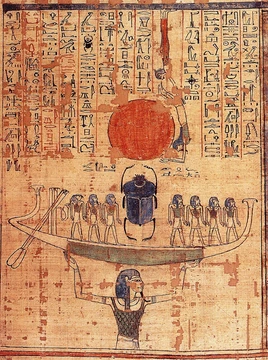
Set (Egyptological: Sutekh - swtẖ ~ stẖ or: Seth) is a god of deserts, storms, disorder, violence, and foreigners in ancient Egyptian religion. In Ancient Greek, the god's name is given as Sēth (Σήθ). He had a positive role accompanying Ra on his barque to repel Apep, the serpent of Chaos, and was lord of the Red Land (desert), balancing Horus's role as lord of the Black Land (fertile land). In the Osiris myth, Set is portrayed as the usurper who murdered and mutilated his own brother, Osiris.
- siblings
- Osiris, Isis, Nephthys, Horus the Elder
Lore & Background
Set is the son of Geb, the Earth, and Nut, the Sky; his siblings are Osiris, Isis, Nephthys, and Horus the Elder. He married Nephthys, and though it has commonly been assumed that they were the parents of Anubis, some Egyptologists have doubted whether Set was ever regarded as Anubis's father. Set also had relationships with the foreign goddesses Anat and Astarte in some accounts. The meaning of the name Set is unknown, but it is thought to have been originally pronounced *sūtiẖ based on spellings in Egyptian hieroglyphs as stẖ and swtẖ. In art, Set is usually depicted as an enigmatic creature referred to by Egyptologists as the Set animal, which has not been definitively identified as any known species. Hypothesized identities include the Saluki, aardvark, African wild dog, donkey, hyena, jackal, pig, antelope, giraffe, and fennec fox. The animal has a downward curving snout; long ears with squared-off ends; a thin, forked tail with sprouted fur tufts in an inverted arrow shape; and a slender canine body. During the Late Period, Set is usually depicted as a donkey or as a man with the head of a donkey, and in the Book of the Faiyum, Set is depicted with a flamingo head. An important element of Set's mythology was his conflict with his brother or nephew, Horus, for the throne of Egypt. The contest is often violent but also described as a legal judgment before the Ennead. The rivalry is portrayed in two contrasting ways: in some spells, Horus is the son of Osiris and nephew of Set, while another tradition depicts Horus and Set as brothers. The divine struggle involves many episodes, including Set sexually abusing Horus, and mutilations where Horus injures or steals Set's testicles and Set damages or tears out one of Horus's eyes.
Reader's Guide
Set's significance in ancient Egyptian religion is complex, encompassing both destructive and protective roles. As a god of deserts, storms, disorder, violence, and foreigners, he represented the chaotic forces that threatened the ordered world of the Nile Valley. Yet he also served a vital protective function, standing on the prow of Ra's barge to defeat the dark serpent Apep, and was described in the Amduat as having a key role in overcoming Apep. His conflict with Horus for the throne of Egypt is a central myth, reflecting the struggle between order and chaos, and the legal judgment before the Ennead established precedents for kingship. The mutilation and restoration of Horus's eye and Set's testicles symbolize cosmic cycles such as the moon's phases. During the Second Intermediate Period and later, Set's portrayal evolved, sometimes taking on a falcon's head in the guise of Horus. His legacy endures as a deity who embodied both the necessary balance of opposites and the perennial tension between civilization and wilderness.
Did You Know?
- Set is the son of Geb (Earth) and Nut (Sky), and his siblings are Osiris, Isis, Nephthys, and Horus the Elder.
- The Set animal, used to depict Set in art, has not been definitively identified as any known species; hypotheses include the aardvark, African wild dog, donkey, and giraffe.
- In the conflict with Horus, Set sexually abuses Horus, and later Horus impregnates Set by placing his semen on lettuce leaves that Set eats.
- During the Late Period, Set is usually depicted as a donkey or as a man with the head of a donkey.
Set as the Disruptive Force in the Osiris Cycle
Within the pantheon of ancient Egyptian deities, Set occupies the role of the disruptive antagonist at the heart of the Osiris myth. This narrative, one of the most significant episodes drawn from the mythic past, centers on the conflict between Osiris, Isis, and Horus on one side and Set on the other, the latter embodying the forces of disorder that threaten maat, the fundamental cosmic order. The struggle is not a single isolated event but a recurring thematic pillar of Egyptian religious thought, representing the perpetual tension between those who sustain order and those who seek to unravel it. What makes Set's portrayal particularly layered is the sheer variability across surviving sources. Egyptian texts rarely present a complete, unified account; instead they offer brief fragments, and the details of his actions shift dramatically from one document to another, sometimes appearing outright contradictory. Rather than reading this as mere inconsistency, scholars interpret each variant as a distinct symbolic lens, each enriching the broader picture of what Set represents. The myth is anchored in the earliest, linear stretch of time, establishing a pattern that the cyclical present then perpetually reenacts to renew cosmic order.
Set as the Personification of Chaos
Egyptian mythology operates, at its deepest level, as a system of metaphor. The deities do not function as literal characters in a conventional narrative; they are symbolic renderings of natural forces and cosmic principles, translated into terms that human minds can grasp. Set, within this framework, is far more than a story-villain. He is the living embodiment of chaos itself, the disorder that perpetually presses against the boundaries of maat. The Egyptians understood their world as a fragile island of stability. The Nile valley, with its dependable annual floods and rich agricultural output, represented the ideal of order, while the surrounding harsh desert, home to peoples they regarded as uncivilized enemies of that order, symbolized the encroaching chaos. Set's mythological role mirrors this geographical and philosophical reality: he is the ever-present threat from beyond the known, orderly world. The triad of themes—order, chaos, and renewal—that defines his narrative is not confined to a single tale but permeates Egyptian religious thought as a whole, surfacing repeatedly across creation stories, the reign of Ra upon the earth, and the Osiris cycle itself.
Set and the Unification of Egypt
One of the most compelling dimensions of Set's mythological identity is its possible tether to genuine political history. Egyptian textual traditions connect the mythic rivalry of Horus and Set to a historical clash between the regions of Upper and Lower Egypt, a confrontation that may have unfolded in the late Predynastic era or the Early Dynastic Period. This linkage suggests that Set's narrative role was shaped, at least in part, by real events of territorial and political struggle between the two halves of the land. The unification of Egypt around 3100 BC transformed the religious landscape profoundly. The pharaoh became the central focus of Egyptian religion, and the ideology of kingship was woven into the mythological framework as a sacred inheritance. In the aftermath of unification, deities who had once served as local patron gods were elevated to national significance, and new relationships were forged among them, binding formerly separate traditions into a cohesive whole. Egyptologist Geraldine Pinch has suggested that early myths may have crystallized from precisely these newly formed inter-regional divine relationships, meaning Set's antagonistic role may carry the faint echo of a genuine historical rivalry.
Set in Art, Literature, and Ritual Life
The influence of Set's mythological narratives extended far beyond theology, permeating virtually every creative and ceremonial expression in ancient Egyptian culture. Iconography and symbolic motifs rooted in these narratives adorned the walls of tombs, the surfaces of temples, and the small amulets carried by individuals, embedding his story into the physical spaces where Egyptians lived, worshipped, and prepared for the afterlife. In the literary sphere, fragments of Set's story were repurposed into narratives spanning a wide emotional register, from lighthearted humor to weighty allegory, showing just how versatile Egyptian authors were in bending sacred material to their creative needs. Religious rituals, too, drew heavily on these narratives, and mythology provided the ideological foundation upon which kingship was justified and sustained. Yet the sources that survive—hymns, ritual texts, funerary inscriptions, temple decorations—rarely offer a complete account of Set's story, presenting instead brief, scattered fragments. This patchwork nature means our understanding of his role remains, in many ways, a mosaic assembled from dispersed pieces, each variant offering a different angle on the same fundamental conflict between order and its disruption.
Common Misconceptions (Editorial)
- Some people assume Set was purely evil or a villain, but the facts show he had a positive role accompanying Ra on his barque to repel Apep, the serpent of Chaos, and served as lord of the Red Land, balancing Horus’s role. - It is commonly believed that Set and Nephthys were definitely the parents of Anubis, but some Egyptologists have doubted whether Set was ever regarded as Anubis’s father. - Another misconception is that Set was always depicted as a donkey or a man with a donkey head; in fact, for much of Egyptian history, he was shown as the enigmatic Set animal, which has not been definitively identified as any known species.
Why It Matters (Editorial)
Set endures as a figure of complexity in mythology, embodying the essential tension between chaos and order that ancient Egyptians saw as necessary for cosmic balance. His story reflects how cultures grapple with ambiguity, portraying even destructive forces as having protective and necessary roles within a larger system.
Frequently Asked Questions
Who is Set in Egyptian mythology?
Set is a major deity in ancient Egyptian religion associated with deserts, violent storms, chaos, and outsiders. His name was rendered as Sēth by the Greeks, and Egyptologists also write it as Sutekh or Seth.
What role does Set play in the myths?
Set serves as the lord of the Red Land (the desert), acting as a counterweight to Horus, who rules the fertile Black Land. He also has a protective function, riding alongside Ra's solar barque to drive away Apep, the chaos serpent.
What is Set's most famous story?
In the Osiris cycle, Set kills his own brother Osiris and dismembers his body, scattering the pieces across Egypt. This act of fratricide sets off the entire saga of Isis searching for the body and Horus avenging his father.
Who are Set's siblings?
Set is the brother of Osiris, Isis, Nephthys, and Horus the Elder, placing him at the center of the core family that drives the Osiris myth.
Why is Set important to Egyptian religion?
Set embodies the necessary chaos and wildness of the desert that balances the order of the cultivated land. Rather than being purely evil, he fulfills a vital cosmological role—both as a destroyer and as Ra's defender against the serpent of chaos.
Spotted an error? Know more?
This is a living reference — every entry is fact-audited, and reader corrections feed straight into our audit queue. Suggest an edit · See this site's audit record