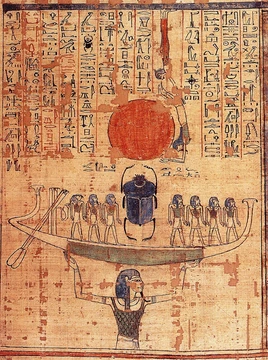
Aten
Solar disc deity and sole god of Atenism under Akhenaten.

Aten, also spelled Aton, Atonu, or Itn, was the focus of Atenism, the religious system formally established in ancient Egypt by the late Eighteenth Dynasty pharaoh Akhenaten. Originally an aspect of the sun god Ra, Aten was depicted as a solar disc emitting rays terminating in human hands. The worship of Aten and the coinciding rule of Akhenaten define the Amarna Period (c.
- field
- Ancient Egyptian religion
- known_for
- Sole deity of Atenism under Akhenaten
- nationality
- Ancient Egyptian
- cult_center
- Akhetaten (Amarna)
Lore & Background
The word Aten appears in the Old Kingdom as a noun meaning 'disc,' referring to anything flat and circular; the sun was called the 'disc of the day.' By analogy, 'silver aten' sometimes referred to the moon. The first known reference to Aten as a deity is in The Story of Sinuhe from the 12th Dynasty, where the deceased king is described as 'uniting with the sun-disk.' Under Amenhotep III, Aten was worshipped as a falcon-headed god like Ra, but it was not until his successor Akhenaten that Aten became the sole god of state worship, a system called Atenism. Akhenaten changed his name from Amenhotep IV to reflect his link with the supreme deity and founded the capital Akhetaten (Amarna) as the cult center.
Reader's Guide
Atenism represents a significant departure from traditional ancient Egyptian polytheism, as Aten was made the sole deity of state worship under Akhenaten. The religion did not persist beyond Akhenaten's death; his successor Tutankhamun reopened state temples to other gods and re-positioned Amun as the pre-eminent solar deity. Aten's iconography was unique: represented as a sun disc with rays ending in human hands, no statues were allowed, and temples were open-air to admit sunlight. The Aten was considered intangible and beyond creation, and later iconoclasm even prohibited sun disc depictions, requiring the name to be spelled phonetically. Atenism's legacy includes debate over whether it constitutes one of the first examples of monotheism, though household worship of traditional gods likely continued. The Amarna period remains a key subject for understanding religious innovation and state power in ancient Egypt.
Did You Know?
- Aten is depicted as a solar disc emitting rays terminating in human hands.
- The first known reference to Aten as a deity is in The Story of Sinuhe from the 12th Dynasty.
- Temples of Aten were open and did not have roofs to allow sunlight inside.
- There is only one known instance of the Aten talking in inscriptions.
Common Misconceptions (Editorial)
- A common misconception is that Aten was only ever a sun god. While Aten was originally an aspect of the sun god Ra, the term "Aten" initially referred to any flat, circular object, and “silver aten” sometimes referred to the moon. - Some people believe Atenism began with Amenhotep III. In fact, while Aten was worshipped under Amenhotep III as a falcon-headed god, it was not until his successor Akhenaten that Aten became the sole god of state worship.
Why It Matters (Editorial)
Aten’s rise under Akhenaten represents one of history’s earliest experiments in rigid monotheism, a dramatic break from Egypt’s rich polytheistic tradition. The period endures as a fascinating case study in how political power can reshape religion, art, and society—an echo that still resonates in modern debates about authority and belief.
Frequently Asked Questions
Who is Aten in Egyptian mythology?
Aten is a solar disc deity who, during the late Eighteenth Dynasty, became the exclusive god of a monotheistic faith known as Atenism. Before that elevation, Aten was understood as merely one facet of the broader sun god Ra.
How is Aten depicted in Egyptian art?
Aten is shown as a circular sun disc with long rays stretching outward, each ray capped by a small outstretched hand. This imagery conveys the idea that Aten personally reaches down to touch and sustain every living being.
What is Atenism and how did it differ from traditional Egyptian religion?
Atenism was a religious system that recognized Aten as the single true deity, replacing the usual Egyptian pantheon with one exclusive god. It was formally instituted by Pharaoh Akhenaten, who also built the city of Akhetaten (modern Amarna) as its cult center.
Who established the worship of Aten as Egypt's sole god?
Pharaoh Akhenaten of the late Eighteenth Dynasty restructured the state religion around Aten, making the solar disc the only object of official worship. His reign and the accompanying religious upheaval define what Egyptologists call the Amarna Period.
Spotted an error? Know more?
This is a living reference — every entry is fact-audited, and reader corrections feed straight into our audit queue. Suggest an edit · See this site's audit record