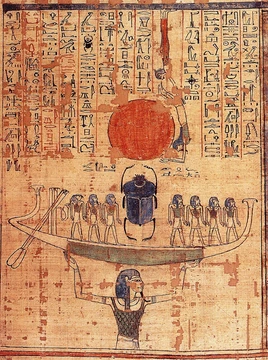
Amun
Ancient Egyptian deity, hidden king of the gods.

Amun was a major ancient Egyptian deity, first attested in the Old Kingdom. He appears as a member of the Hermopolitan Ogdoad and rose to become the patron deity of Thebes, later fusing with the sun god Ra as Amun-Ra, the king of the gods and a transcendental creator deity.
- field
- Ancient Egyptian religion
- nationality
- Egyptian
- known_for
- King of the gods; fusion with Ra as Amun-Ra; patron of Thebes; oracle at Siwa Oasis
- associated_with
- Mut, Khonsu, Min, Ra
Lore & Background
Amun is attested from the Old Kingdom together with his wife Amunet. His name meant 'the hidden one' or 'invisible,' as noted in the Pyramid Texts. He was initially possibly one of eight deities in the Hermopolitan creation myth. With the 11th Dynasty (c. 21st century BC), Amun rose to the position of patron deity of Thebes, replacing Montu. His oracle at Siwa Oasis in Western Egypt remained the only oracle of Amun throughout. After the rebellion of Thebes against the Hyksos and the rule of Ahmose I (16th century BC), Amun acquired national importance and fused with Ra as Amun-Ra. He was also thought to be the king of the gods. As the chief deity of the Egyptian Empire, Amun-Ra came to be worshiped outside Egypt, identified with Zeus in Greece and Jupiter in Rome.
Reader's Guide
Amun's significance lies in his evolution from a local Theban deity to the supreme god of the Egyptian pantheon during the New Kingdom (16th–11th centuries BC). As Amun-Ra, he was considered a transcendental, self-created creator deity and the champion of the poor and troubled, central to personal piety. His cult expanded beyond Egypt into Libya and Nubia, where he was identified with Zeus and Jupiter. The Precinct of Amun-Ra at Karnak, begun under Senusret I, became a major religious center, with construction continuing through the 18th Dynasty and later. During the Amarna Period, Akhenaten's Atenism directly competed with Amun's worship, but after Akhenaten's death, the old polytheistic religion was re-established. Amun's legacy includes his association with the ram-headed deity of Kush and his absorption of the fertility god Min, becoming Amun-Min. He remains one of the most widely recorded Egyptian gods, alongside Osiris.
Did You Know?
- Amun's name meant 'the hidden one' or 'invisible,' as attested in the Pyramid Texts.
- His oracle at Siwa Oasis in Western Egypt remained the only oracle of Amun throughout.
- Amun-Ra was identified with Zeus in Greece and Jupiter in Rome.
- Amun became associated with a ram-headed deity after Egypt conquered Kush.
Common Misconceptions (Editorial)
Some people believe Amun was always a major national deity, but he first appears as a member of the Hermopolitan Ogdoad and only rose to prominence as patron of Thebes during the 11th Dynasty. Others assume he was always fused with Ra, whereas Amun was originally distinct and only merged into Amun-Ra after the Hyksos period under Ahmose I. It is also a mistake to think Amun had multiple oracles; in fact, his oracle at Siwa Oasis remained the only oracle of Amun throughout.
Why It Matters (Editorial)
Amun’s evolution from a local Theban god to the king of the gods reflects ancient Egypt’s political and religious shifts, showing how belief systems adapt to power structures. His identification with Zeus and Jupiter demonstrates how Egyptian religion influenced and was absorbed by other ancient cultures, underscoring the enduring human impulse to find common divine archetypes across civilizations.
Frequently Asked Questions
Who is Amun in Egyptian mythology?
Amun is an ancient Egyptian god whose name essentially means 'the hidden one,' pointing to his nature as an invisible force behind creation. He first appears in Old Kingdom records as part of the Hermopolitan Ogdoad and later rose to become the supreme patron deity of Thebes.
How did Amun become Amun-Ra?
As Thebes grew into Egypt's political heart, priests merged Amun's identity with the sun god Ra to unite the two most powerful cults under a single name. This syncretism elevated him to the title 'king of the gods' and recast him as a transcendental creator who exists beyond the visible cosmos.
Who are Amun's family members?
Amun is traditionally paired with the goddess Mut as his consort, and their son is the moon god Khonsu. He is also closely linked to the fertility god Min and, through the Amun-Ra fusion, to Ra himself.
What was Amun's oracle at Siwa?
The oracle at Siwa Oasis in the western desert became one of the most renowned prophetic sites in the ancient world, where priests delivered answers in Amun's name to pharaohs and foreign rulers alike. Alexander the Great famously consulted this oracle before entering Egypt.
Why is Amun called a 'hidden' god?
His name derives from a root meaning 'to conceal,' suggesting a deity who works behind the scenes of the visible world rather than appearing directly. This hidden quality made him a symbol of the unseen creative power underlying all of existence.
Spotted an error? Know more?
This is a living reference — every entry is fact-audited, and reader corrections feed straight into our audit queue. Suggest an edit · See this site's audit record