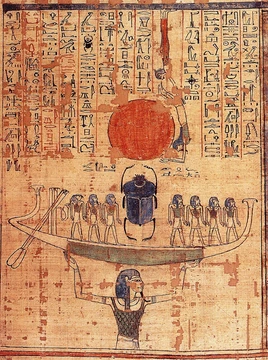
Anubis
God of funerary rites, protector of graves, and guide to the underworld.

Anubis, also known as Inpu, Anpu, or Anoup, is the ancient Egyptian god of funerary rites, protector of graves, and guide to the underworld. He is usually depicted as a canine or a man with a canine head, and is one of the most frequently depicted and mentioned gods in the Egyptian pantheon, though few major myths involved him.
- field
- Ancient Egyptian religion
- known_for
- God of funerary rites, protector of graves, guide to the underworld, embalmer, psychopomp
- nationality
- Ancient Egyptian
- other_names
- Inpu, Anpu, Jnpw, Anoup
Lore & Background
Anubis assumed different roles in various contexts. Depicted as a protector of graves as early as the First Dynasty (c. 3100 – c. By the Middle Kingdom (c. One of his prominent roles was ushering souls into the afterlife and attending the weighing scale during the 'Weighing of the Heart,' determining whether a soul would enter the realm of the dead. Anubis was depicted in black, a color symbolizing regeneration, life, the soil of the Nile, and the discoloration of the corpse after embalming. He is associated with Wepwawet, another canine-headed god, and historians assume the two were eventually combined. His female counterpart is Anput, and his daughter is the serpent goddess Kebechet.
Reader's Guide
Anubis's significance lies in his enduring role as a guardian and guide in the afterlife, a central concern of ancient Egyptian religion. As an embalmer, he was linked to mummification, and as a protector of tombs, he was invoked in prayers carved on most ancient tombs. His role as psychopomp, guiding souls across the threshold, was especially prominent by the late pharaonic era. During the Ptolemaic period, Anubis was merged with the Greek god Hermes to form Hermanubis, reflecting cultural exchange. Despite Greek and Roman scorn for animal-headed gods, Anubis was sometimes associated with Sirius, Cerberus, and Hades. His legacy persisted into the Middle Ages and Renaissance through alchemical and hermetical literature. The variety of his epithets—such as 'First of the Westerners,' 'Lord of the Sacred Land,' and 'He Who Is in the Place of Embalming'—underscores his multifaceted importance in funerary practice and mythology.
Did You Know?
- Anubis was known as 'First of the Westerners,' 'Lord of the Sacred Land,' and 'The Dog who Swallows Millions.'
- In the Old Kingdom, Anubis was the most important god of the dead, later replaced by Osiris during the Middle Kingdom.
- Anubis was merged with the Greek god Hermes during the Ptolemaic period, becoming Hermanubis.
- The Greek writer Plutarch reported a tradition that Anubis was the illegitimate son of Nephthys and Osiris, adopted by Isis.
Roles & Functions in Egyptian Religion
Anubis occupied a remarkably versatile position within the Egyptian divine hierarchy, shifting his responsibilities across millennia. From the First Dynasty around 3100 BC, he served as a guardian of burial sites, a role born from the practical threat jackals posed to freshly interred bodies. He also functioned as an embalmer, overseeing the preparation of the dead. His most iconic duty was attending the Weighing of the Heart, where a deceased soul's organ was balanced against a feather to determine its eligibility for the afterlife. During the Old Kingdom, he stood as the preeminent deity of the dead. However, by the Middle Kingdom, Osiris supplanted him as lord of the underworld, though Anubis retained his role as the soul's usher into the realm of the departed. In the Roman era, tomb paintings show him gently holding the hand of the deceased, guiding them toward Osiris. Despite being one of the most frequently depicted and referenced gods in the entire Egyptian pantheon, remarkably few major myths centered on him personally.
Iconography & Symbolism
The visual identity of Anubis is immediately striking: a canine or a humanoid figure crowned with a jackal's head. His consistent association with the color black carries layered meaning. Black symbolized regeneration and life, evoked the fertile soil deposited by the Nile's annual floods, and mirrored the darkening of a corpse following the embalming process. This chromatic choice thus tied the god simultaneously to the promise of new life and the reality of death. Anubis is linked to Wepwawet, another canine-headed deity distinguished by grey or white fur, and scholars believe the two figures were eventually merged into a single divine identity. Within the family structure of the pantheon, his female counterpart is Anput, while his daughter is the serpent goddess Kebechet. In the Early Dynastic period, he appeared in full animal form with both jackal head and body, a representation rooted in the very scavenging behavior that made jackals both a threat to graves and, by the logic of symbolic counteraction, their natural protectors.
Name, Titles & Linguistic Heritage
The name Anubis is actually a Greek adaptation, first applied after Greek contact with Egypt around the seventh century BC. Before that, the god was known as Anpu or Inpu in Egyptian, a name whose root carries the meaning of a royal child. Interestingly, the Inpu root also connects to the word for decay, embedding a paradox of nobility and decomposition within a single name. His hieroglyphic rendering in the Old Kingdom combined the sound signs inpw with a jackal perched atop a ḥtp sign, later evolving to place the jackal on a tall stand. His pronunciation may have been something like a-na-pa, reconstructed from Coptic and Akkadian transcriptions. Beyond his name, Anubis accumulated a remarkable catalogue of titles: First of the Westerners, Lord of the Sacred Land, Master of Secrets, He Who Is in the Place of Embalming, The Dog who Swallows Millions, and Ruler of the Nine Bows, each reflecting a distinct facet of his divine authority.
Cross-Cultural Legacy & Evolution
Anubis's parentage shifted dramatically across eras and sources, reflecting the fluidity of Egyptian theology. Early texts named him a son of Ra; the Coffin Texts made him offspring of Hesat or Bastet; other traditions paired Ra with Nephthys as his parents. The most widespread tradition identified him as the child of Osiris and Isis, though Plutarch recorded a variant in which Nephthys bore him through a mistaken union with Osiris, and Isis subsequently adopted him after dogs led her to the abandoned infant. During the Ptolemaic period, as Egypt became a Hellenistic kingdom, Anubis was syncretized with the Greek Hermes to produce Hermanubis, a fusion grounded in their shared role as guides of souls. The cult centered on Cynopolis, a place whose Greek name means city of dogs. Apuleius's Golden Ass confirms the worship persisted in Rome into the second century, and Hermanubis resurfaced in medieval alchemical and hermetical texts. Even Plato's Socrates invoked the dog of Egypt as an oath of truth.
Common Misconceptions (Editorial)
Some people assume Anubis was always depicted with a canine head, but fact-checked records show he is also shown as a full canine. Another common error is believing that Anubis was always the chief god of the dead in Egyptian religion; in fact, he held that role primarily in the Old Kingdom and was later replaced by Osiris during the Middle Kingdom.
Why It Matters (Editorial)
Anubis endures because he embodies humanity’s enduring concern with death, transition, and moral judgment—questions that transcend any single culture or era. His striking image as a protective, jackal-headed guide continues to resonate in modern art, literature, and film, serving as a timeless symbol of the boundary between life and the unknown afterlife.
Frequently Asked Questions
Who is Anubis?
Anubis is an ancient Egyptian deity tied to funerary rites, the guarding of burial sites, and guiding souls into the afterlife. He serves as both an embalmer and a psychopomp, making him central to how Egyptians understood death and the journey beyond.
What is Anubis's role in Egyptian mythology?
His core duties involve overseeing embalming, protecting graves, and escorting the deceased through the underworld. He acts as a psychopomp, bridging the gap between the world of the living and the realm of the dead.
How is Anubis typically depicted?
He is most often shown as a jackal or as a human figure bearing a canine head. This animal-headed form has made him one of the most visually recognizable figures across the entire Egyptian pantheon.
What are Anubis's alternative names?
Beyond the familiar name Anubis, he is also called Inpu, Anpu, Jnpw, or Anoup. These variants simply reflect different transliterations of his name from ancient Egyptian sources.
Why is Anubis so prominent if few major myths center on him?
He ranks among the most frequently depicted and referenced gods in Egyptian religion because his domain—death and the afterlife—was a constant part of everyday life. His practical role in funerary practice gave him a widespread presence even without elaborate narrative cycles.
Spotted an error? Know more?
This is a living reference — every entry is fact-audited, and reader corrections feed straight into our audit queue. Suggest an edit · See this site's audit record