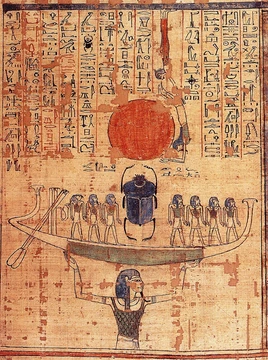
Osiris
God of the afterlife, resurrection, and vegetation in ancient Egypt.

Osiris was a major god in ancient Egyptian religion, associated with fertility, agriculture, the afterlife, the dead, resurrection, life, and vegetation. He was classically depicted with a pharaoh's beard, partially mummy-wrapped legs, an atef crown, and a crook and flail. He was one of the first gods linked to the mummy wrap and was widely worshipped until the decline of ancient Egyptian religion.
- field
- Ancient Egyptian religion
- known_for
- God of the afterlife, resurrection, and vegetation; lord of the dead and underworld
- nationality
- Egyptian
- epithets
- Lord of Silence, Khenti-Amentiu (Foremost of the Westerners), He Who is Permanently Benign and Youthful
Lore & Background
Osiris was at times considered the eldest son of the earth god Geb and the sky goddess Nut, brother and husband of Isis, and brother of Set, Nephthys, and Horus the Elder. His brother Set killed him and cut him into pieces; his sister-wife Isis, with Nephthys, searched Egypt and collected all but his genitalia. She wrapped his body, enabling him to return to life. Horus the Younger was considered his posthumously begotten son. Through syncretism with Iah, he was also a moon god.
Reader's Guide
Osiris was the lord of the dead and the underworld, known as 'Lord of Silence' and Khenti-Amentiu ('Foremost of the Westerners'). In the Old Kingdom, pharaohs were considered sons of Ra who ascended to the sky after death. After the spread of the Osiris cult, kings were associated with Osiris in death: as Osiris rose from the dead, they would unite with him and inherit eternal life through imitative magic. He became associated with cycles in nature, including the sprouting of vegetation, the annual Nile flood, and the heliacal rising of Orion and Sirius at the new year. He was the sovereign that granted all life, 'He Who is Permanently Benign and Youthful'. The first evidence of his worship is from the middle of the Fifth Dynasty (25th century BCE), though the Khenti-Amentiu epithet dates to at least the First Dynasty. Most information on the Osiris myth comes from allusions in the Pyramid Texts, New Kingdom sources like the Shabaka Stone and 'The Contendings of Horus and Seth', and later Greek authors including Plutarch and Diodorus Siculus.
Did You Know?
- Osiris was one of the first gods associated with the mummy wrap.
- His name in Egyptian hieroglyphs appears as wsjr, with various vocalizations including Asar, Ausar, Wesir, and Usir.
- The djed pillar was usually understood as the backbone of Osiris.
- A living sacred ram was kept at Mendes as the incarnation of the god Banebdjed, an aspect of Osiris.
The Narrative Arc of Murder, Restoration, and Vengeance
The Osiris myth unfolds as a sweeping family drama that begins with fratricide. Set, the brother of Osiris—a primeval king of Egypt—kills him and seizes the throne. But the story does not end with death. Isis, Osiris's wife, gathers and restores his scattered body, and through this act enables a posthumous union that conceives their son Horus. The narrative then pivots to the next generation: Horus, initially a vulnerable child shielded by his mother, grows into Set's rival for the Egyptian throne. Their conflict is often violent and protracted, but it ultimately resolves in Horus's triumph. This victory does more than settle a political dispute; it restores maat—the cosmic and social order that Set's unrighteous reign had shattered—and completes the process of Osiris's resurrection. The myth thus weaves together themes of betrayal, maternal devotion, generational justice, and the restoration of universal harmony into a single, interlocking narrative.
Religious Resonance and Popular Appeal
The Osiris myth occupied a uniquely central place in ancient Egyptian religious life, and its influence extended far beyond elite theological circles. Among ordinary Egyptians, the story resonated because its core spiritual message was deeply personal: it implied that any deceased individual could attain a pleasant afterlife, not just kings. The characters themselves—Osiris, Isis, Horus, and Set—carried emotional weight that mirrored real human experience. As Egyptologist J. Gwyn Griffiths observed, the myth conveys a powerful sense of family loyalty and devotion, particularly in the bonds between Osiris, Isis, and Horus. This made the story more accessible and emotionally compelling than most other Egyptian myths, whose characters tend to feel more abstract. The myth also served as a foundational framework for understanding kingship and succession, the tension between order and disorder, and the mechanics of death and the afterlife. Many elements of the worship of the four central deities were drawn directly from the narrative, embedding the story into the fabric of daily religious practice.
A Fragmentary Mosaic of Texts and Traditions
No single ancient Egyptian source provides a complete, unified account of the Osiris myth. Instead, the story survives as a mosaic drawn from an exceptionally wide range of literary and ritual genres. The earliest mentions appear in the Pyramid Texts, funerary spells inscribed on pyramid walls at the close of the Fifth Dynasty, where key elements like Osiris's death and the Horus-Set strife are referenced. Later funerary compositions—the Coffin Texts of the Middle Kingdom and the Book of the Dead of the New Kingdom—carry forward portions of the narrative. Middle Kingdom documents such as the Dramatic Ramesseum Papyrus and the Ikhernofret Stela connect the myth to the coronation of Senusret I and the annual Khoiak festival, respectively. The Great Hymn to Osiris from the Eighteenth Dynasty offers the most complete Egyptian outline of the full story, while the Memphite Theology links Osiris's kingship to the creator god Ptah. Magical healing spells, temple wall inscriptions, and lamentation texts further enrich the picture. Because each text adapted the myth to its own purpose, versions often contradict one another, yet taken together they yield a more cohesive narrative than any other Egyptian myth.
Origins, Dating, and the Question of Historical Roots
Scholars agree that the Osiris myth had reached its basic form by or before the 24th century BCE, though many of its constituent ideas likely predate that milestone. The struggle between Horus and Set, in particular, may have been partly inspired by a genuine regional conflict during the Predynastic or Early Dynastic period, though no definitive conclusion has been reached about the specific historical events behind the story. The dating of key sources has also been a subject of revision. The Memphite Theology, a religious narrative that recounts Osiris's death and the resolution of the Horus-Set dispute, was long assumed to originate in the Old Kingdom and was treated as evidence for the myth's earliest stages. Since the 1970s, however, Egyptologists have concluded the text dates no earlier than the New Kingdom, complicating earlier assumptions about the myth's development. Greek and Roman writers, especially Plutarch in his treatise On Isis and Osiris, preserved additional details that Egyptian sources do not provide, though their accounts may not always faithfully reflect native beliefs. Through these later transmissions, the myth survived the loss of most ancient Egyptian religious knowledge and remains widely recognized to this day.
Common Misconceptions (Editorial)
Some believe Osiris was solely a god of the dead with no connection to life, but the facts show he was also associated with fertility, agriculture, resurrection, and vegetation. Others mistakenly think he was always depicted fully as a living pharaoh, whereas the facts state he was classically depicted with partially mummy-wrapped legs, linking him to the mummy wrap. It is also sometimes assumed that Horus the Younger was always Osiris's son before his death, but the facts specify Horus was considered his posthumously begotten son.
Why It Matters (Editorial)
Osiris endures as a powerful symbol of the cycle of death and rebirth, reflecting humanity’s ancient struggle to find meaning in mortality. His story of murder, dismemberment, and resurrection speaks to a universal hope for renewal that continues to resonate in modern culture and spirituality.
Frequently Asked Questions
Who is Osiris in Egyptian mythology?
Osiris is one of the most prominent deities in ancient Egyptian religion, governing the realm of the dead, the cycle of vegetation, and the concept of resurrection. He is often remembered as a former king of Egypt who was murdered by his brother Set and later restored to life by his wife Isis.
What is Osiris's role in the afterlife?
He serves as the judge and sovereign of the underworld, overseeing the fate of souls after death. In his capacity as lord of the dead, he embodies the idea that death is a transition into renewed existence rather than a final end.
How is Osiris typically depicted in Egyptian art?
He is shown with his legs wrapped in mummy bandages, wearing the tall atef crown of Upper Egypt, and holding the traditional crook and flail symbols of kingship. His face often bears a pharaoh's false beard, reinforcing his identity as a royal figure.
Why is Osiris linked to both death and fertility?
His myth mirrors the seasonal flooding of the Nile, where the land appears to die in the dry season and is reborn when the waters return. This cycle made him a natural symbol for both the end of life and the renewal of crops and vegetation.
What are some of Osiris's key titles and epithets?
He is known by names such as Khenti-Amentiu, meaning 'Foremost of the Westerners,' which ties him to the western desert where the dead were buried. Other honorifics include 'Lord of Silence' and 'He Who is Permanently Benign and Youthful,' reflecting his eternal, undying nature.
Spotted an error? Know more?
This is a living reference — every entry is fact-audited, and reader corrections feed straight into our audit queue. Suggest an edit · See this site's audit record