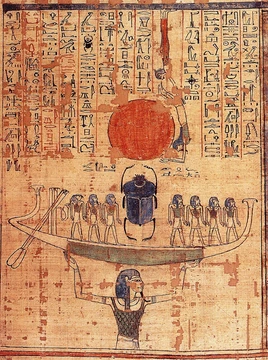
The Ennead
Group of nine deities in Egyptian mythology worshipped at Heliopolis.

The Ennead, also known as the Great Ennead, was a group of nine deities in Egyptian mythology worshipped at Heliopolis. It included the sun god Atum; his children Shu and Tefnut; their children Geb and Nut; and their children Osiris, Isis, Set, and Nephthys. The Ennead sometimes includes Horus the Elder, an ancient form of the falcon god, not the son of Osiris and Isis. The Great Ennead was only one of several such groupings of nine deities in ancient Egypt, and claims to preeminence made by its Heliopolitan priests were not respected throughout Egypt, as each nome typically had its own local deities.
- Name in Egyptian
- Pesedjet (conventional transcription)
- Name in Greek
- enneás (ἐννεάς), meaning 'the nine'
- Name in Latin
- ennead (borrowing via Latin)
- Members
- Atum, Shu, Tefnut, Geb, Nut, Osiris, Isis, Set, Nephthys (sometimes Horus the Elder)
- Location
- Heliopolis (Awanu)
- Period
- Old Kingdom to Ptolemaic period
- Known for
- Heliopolitan creation myth and family of the sun god Atum
Lore & Background
According to the creation story of the Heliopolitan priests, the world originally consisted of the primordial waters of precreation personified as Nun. From it arose a mound on the First Occasion, upon which sat the self-begotten god Atum, equated with the sun god Ra. Atum evolved from Nun through self-creation, then either spat or masturbated, producing air personified as Shu and moisture personified as Tefnut. The siblings Shu and Tefnut mated to produce the earth personified as Geb and the nighttime sky personified as Nut. Geb and Nut were the parents of Osiris and Isis and of Set and Nephthys, who became respective couples in turn. Osiris and Isis represent fertility and order, while Set and Nephthys represent chaos to balance them. Horus, the son of Osiris and Isis, is often included in this creation tradition.
Reader's Guide
The Great Ennead was the most important of several enneads in ancient Egypt, thriving from the Old Kingdom to the Ptolemaic period. Its development remains uncertain, although it appears to have first appeared when Ra's cult—supreme under Dynasty V—declined in importance under Dynasty VI. Egyptologists have traditionally theorized that the Heliopolitan priesthood established it to assert the preeminence of Atum over others, incorporating some major gods in lesser positions and omitting others entirely. The most prominent of such deities was Osiris, god of vegetation and the afterlife, who was incorporated as Atum's great-grandson. However, in the 20th century, some Egyptologists question the whole scenario. After the Great Ennead was well established, the cult of Ra—identified with Atum—recovered much of its importance until superseded by the cult of Horus, and the two were then combined as Ra-Horus of the Horizons. The Ennead's creation story is one of several in Egyptian mythology, and the Egyptians believed no specific myth was more correct than another, but rather that some combination of these myths was correct.
Did You Know?
- The English name 'ennead' is a borrowing via Latin of the Greek name enneás, meaning 'the nine', which was a calque of the Egyptian name psḏt, also meaning 'the Nine'.
- Some pharaohs established enneads that incorporated themselves as gods; Seti I of Dynasty XIX celebrated an ennead of six major gods and three deified forms of himself.
- The Ennead sometimes includes Horus the Elder, an ancient form of the falcon god, not the son of Osiris and Isis.
- The Pyramid Texts of Dynasties V and VI mention the 'Great Ennead', the 'Lesser Ennead', the 'Dual Ennead', and the 'Seven Enneads'.
Common Misconceptions (Editorial)
Some people mistakenly believe that the Ennead always included Horus, the son of Osiris and Isis, but the facts show that when Horus is included, it is Horus the Elder, an ancient form of the falcon god. Another common error is assuming the Ennead’s creation story was accepted throughout ancient Egypt, but in reality, each nome typically had its own local deities, and the Heliopolitan priests’ claims to preeminence were not universally respected.
Why It Matters (Editorial)
The Ennead endures because its creation myth offers a rich, human-like family drama that explains the origins of the world, order, and chaos in Egyptian thought. Its structure as a group of nine deities also highlights how ancient cultures used numerical and familial systems to organize religious beliefs, influencing later concepts of pantheons and divine hierarchies.
Spotted an error? Know more?
This is a living reference — every entry is fact-audited, and reader corrections feed straight into our audit queue. Suggest an edit · See this site's audit record