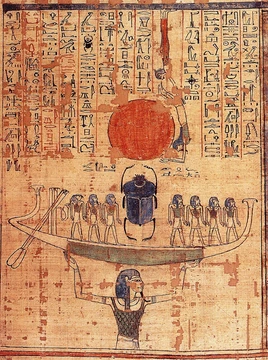
The Duat
Ancient Egyptian realm of the dead and nightly rebirth.

The Duat (also known as Tuat, Te, or Amenthes) is a concept in ancient Egyptian mythology involving death, most often seen as a realm where people go after they die. What is known of the Duat derives principally from funerary texts such as the Book of Gates, the Book of Caverns, the Coffin Texts, the Amduat, and the Book of the Dead, among many other sources.
- Also known as
- Tuat, Te, Amenthes
- Type
- Realm of the dead in ancient Egyptian mythology
- Associated deities
- Osiris, Anubis, Thoth, Horus, Maat, Ra, Apep, Ammit
- Key texts
- Book of Gates, Book of Caverns, Coffin Texts, Amduat, Book of the Dead
- Notable features
- Twelve guarded gates, Hall of Truth, A'aru (Field of Reeds), lakes of fire, walls of iron, trees of turquoise
Lore & Background
The Duat is most often depicted as a setting for rituals and mythological events, especially the journey and judgment of the soul after death and the nightly rebirth of the sun god Ra. It is divided into sections by twelve guarded gates representing each hour of the night, closely associated with Ra's journey and featuring Osiris, god of the Duat and personification of rebirth. Burial chambers formed touching-points between the mundane world and the Duat, and the west bank of the Nile was associated with the dead.
Reader's Guide
The Duat is a central concept in ancient Egyptian mythology, representing the afterlife realm where souls journey after death. Its significance lies in its role as the setting for the judgment of the dead, where the heart is weighed against the feather of Maat by Anubis, with Thoth recording the verdict. Souls lighter than the feather pass to A'aru, a paradise of eternal spring and abundant harvests; those heavier are devoured by Ammit, ceasing to exist. The Duat also hosts the nightly journey of Ra, who travels through its twelve regions in his ram-headed form Af, battling Apep to bring order and reviving the dead with his light. The Book of the Dead is considered a vital resource for understanding the Duat, containing spells and prayers to protect the dead from its dangers. The Duat is not equivalent to Hell; the ultimate punishment is denial of afterlife, not eternal torment.
Did You Know?
- The Duat has also been called Te (Coptic) and Amenthes (Ancient Greek).
- The Duat is divided into twelve sections by guarded gates representing each hour of the night.
- A'aru, or the Field of Reeds, is described as a paradise where harvests are never poor and the land is in eternal spring.
- The Duat appears in popular culture including Rick Riordan's The Kane Chronicles, Assassin's Creed Origins, and the Disney+ series Moon Knight.
Common Misconceptions (Editorial)
Some believe the Duat is a single, static underworld, but it is divided into twelve sections by guarded gates, each tied to an hour of the night. Another common error is that only souls of the dead travel through the Duat; in fact, the sun god Ra also journeys through it nightly for rebirth. It is also sometimes assumed the Duat is purely a place of punishment, yet it includes A'aru, the Field of Reeds, described as a paradise with eternal spring and bountiful harvests.
Why It Matters (Editorial)
The Duat endures because it reflects humanity’s timeless need to make sense of death and what may come after, framing the afterlife as a structured, moral journey rather than an end. Its vivid imagery—gates, judgment halls, and a sun god’s nightly rebirth—continues to resonate in modern storytelling, reminding us how ancient myth still shapes our cultural imagination.
Spotted an error? Know more?
This is a living reference — every entry is fact-audited, and reader corrections feed straight into our audit queue. Suggest an edit · See this site's audit record