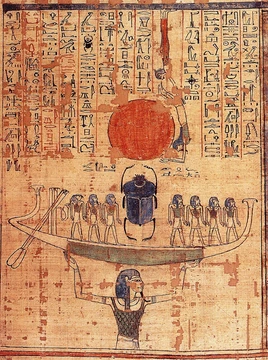
The Book of the Dead
Ancient Egyptian funerary spells for the afterlife journey.

The Book of the Dead is the name given to an ancient Egyptian funerary text generally written on papyrus and used from the beginning of the New Kingdom (around 1550 BC) to around 50 BC. It consists of a loose collection of magic spells intended to assist a dead person's journey through the Duat, or underworld, and into the afterlife. The original Egyptian name for the text is translated as 'Spells of Coming Forth by Day.'
- field
- Funerary text
- culture
- Ancient Egyptian
- period
- c. 1550 BC – c. 50 BC
- known_for
- Collection of spells for the afterlife
- material
- Papyrus scroll
- language
- Hieroglyphic or hieratic script
Lore & Background
The Book of the Dead developed from a tradition of funerary manuscripts dating back to the Egyptian Old Kingdom. These were written on the walls of burial chambers within pyramids and were exclusively for the pharaoh.
Reader's Guide
The Book of the Dead is significant as a key source for understanding ancient Egyptian beliefs about death, the afterlife, and magic. It was not a single canonical work; surviving papyri contain varying selections of spells and illustrations, with some people commissioning their own copies. The spells served purposes such as preserving the deceased's being, guiding them through the underworld, and protecting them from hostile forces. The text was standardized during the 25th and 26th Dynasties as the 'Saite recension,' and its last use was in the 1st century BC. The Book of the Dead reflects the integration of magical and religious practice in ancient Egypt, where hieroglyphic script was held to have been invented by the god Thoth and the hieroglyphs themselves were considered powerful.
Did You Know?
- The original Egyptian name for the Book of the Dead is translated as 'Spells of Coming Forth by Day.'
- The Book of the Dead was most commonly written in hieroglyphic or hieratic script on a papyrus scroll.
- The Book of the Dead was part of a tradition that includes the earlier Pyramid Texts and Coffin Texts.
Common Misconceptions (Editorial)
Some people think "The Book of the Dead" was a single, standardized book, but it was actually a loose collection of magic spells with no fixed order. Others assume it was used throughout all of ancient Egyptian history, yet it dates specifically from around 1550 BC to about 50 BC. A further misconception is that it was always written on tomb walls, whereas the facts confirm it was generally written on papyrus scrolls.
Why It Matters (Editorial)
The Book of the Dead endures because it reveals how ancient Egyptians confronted humanity's oldest questions about death and what comes after. Its spells and rituals offer a window into their beliefs about judgment, resurrection, and the soul's journey—themes that still resonate across cultures and centuries.
Spotted an error? Know more?
This is a living reference — every entry is fact-audited, and reader corrections feed straight into our audit queue. Suggest an edit · See this site's audit record