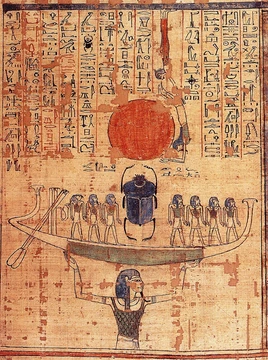
Khonsu
Ancient Egyptian moon god, healer, and creator associated with time and fertility.

Khonsu (also transliterated Chonsu, Khensu, Khons, Chons; Coptic: Shons) is an ancient Egyptian god of the Moon. His name means 'traveller', likely referring to the Moon's nightly journey across the sky. Along with Thoth, he marked the passage of time and was associated with baboons. Khonsu was instrumental in the creation of new life in all living creatures. At Thebes, he formed part of a family triad (the 'Theban Triad') with his mother Mut and father Amun.
- Culture
- Ancient Egyptian
- Domain
- Moon, time, healing, creation
- Cult Centers
- Thebes (Karnak), Memphis, Hibis, Edfu
- Symbols
- Moon disk, crescent moon, sidelock of hair, menat necklace, crook and flail
- Associated Deities
- Thoth, Mut, Amun, Horus, Shu, Osiris
- Epithets
- Traveller, Embracer, Pathfinder, Defender, Healer, Khonsu the sharp
Lore & Background
Khonsu is depicted in art as a mummy with a sidelock of hair, menat necklace, crook and flail, or with a falcon head adorned with the moon disk and crescent. He is mentioned in the Pyramid Texts and Coffin Texts, where he appears in a fierce aspect, but rose to prominence in the New Kingdom, described as the 'Greatest God of the Great Gods'. Most construction of the Karnak temple complex centered on Khonsu during the Ramesside period. The Temple of Khonsu at Karnak preserves a creation myth in which Khonsu is the great snake who fertilizes the Cosmic Egg. His reputation as a healer spread outside Egypt; the Bentresh stela records that a princess of Bekhten was instantly cured upon the arrival of an image of Khonsu. King Ptolemy IV, after being cured of an illness, called himself 'Beloved of Khonsu Who Protects His Majesty and Drives Away Evil Spirits'.
Reader's Guide
Khonsu's significance spans multiple roles in ancient Egyptian religion. As a moon god, his name 'traveller' reflects the Moon's nightly journey, and he was thought to watch over night travelers, protect against wild animals, and aid healing. The crescent moon was linked to fertility: when Khonsu caused the crescent to shine, women conceived and cattle became fertile. In the underworld, early texts depict him as a butcher of gods in the Cannibal Hymn, extracting entrails to empower the deceased king. He served as a death-bringing messenger (Wepwety) and was associated with burning hearts in the Coffin Texts. During the New Kingdom, Khonsu was also worshipped as a creator god, depicted with two falcon heads (representing sun and moon) standing on a crocodile, symbolizing triumph over chaos. The Khonsu cosmogony at Karnak describes him as a primordial serpent who devours Amun's semen, becomes pregnant, and gives birth to the Ogdoad, who create the sun god. His cult at Thebes centered on the form Khonsu-Neferhotep. The lunar cycle was seen as a life cycle: Khonsu as a child or young bull symbolized renewal and spring, while as an old bull he represented the full moon. His legacy endures through his temple at Karnak and his integration into the Theban Triad.
Did You Know?
- Khonsu's name means 'traveller', relating to the Moon's nightly travel across the sky.
- The Bentresh stela records that a princess of Bekhten was instantly cured of an illness upon the arrival of an image of Khonsu.
- In the Khonsu cosmogony, Khonsu is a primordial serpent who devours Amun's semen and gives birth to the eight gods of the Ogdoad.
- Khonsu was depicted as a two-faced child to represent the time when the moon is not visible at night.
Common Misconceptions (Editorial)
Some people believe Khonsu was only a minor moon god, but the facts show he was described in the New Kingdom as the “Greatest God of the Great Gods” and was central to the Theban Triad with Amun and Mut. Another misconception is that his healing reputation was limited to Egypt; in fact, the Bentresh stela records that a princess of Bekhten was instantly cured upon the arrival of an image of Khonsu, demonstrating his influence beyond Egyptian borders. Some also assume his name refers to the moon’s phases, but it actually means “traveller,” referring to the moon’s nightly journey across the sky.
Why It Matters (Editorial)
Khonsu endures as a figure of ancient wisdom because his domain spans time, healing, and creation—concepts that remain deeply human concerns. His role as a healer and protector against evil spirits shows how the moon was not just a celestial body but a source of comfort and divine intervention in daily life. Understanding Khonsu helps us see how ancient Egyptians wove astronomy, medicine, and mythology into a coherent worldview that still captivates modern curiosity.
Spotted an error? Know more?
This is a living reference — every entry is fact-audited, and reader corrections feed straight into our audit queue. Suggest an edit · See this site's audit record