Frequently Asked Questions
The most-asked questions about egyptian myths.
What exactly are Egyptian myths?
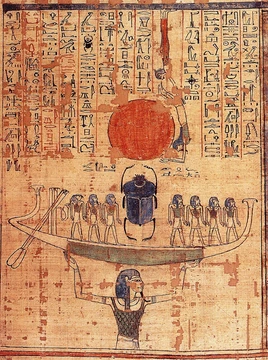
Egyptian myths are a body of sacred narratives developed over roughly three thousand years of ancient Egyptian civilization, describing how the cosmos was created, how the gods interact, and what happens to the soul after death. Unlike Greek mythology, they were never compiled into a single canonical text but survive scattered across temple walls, funerary papyri, and priestly hymns.
Who are the most important figures in Egyptian mythology?
The core cast includes Ra (the sun god and creator), Osiris (the murdered and resurrected king of the dead), Isis (his wife and the great magician), Horus (their son and sky god), Set (the chaos-bringer who killed Osiris), Thoth (god of writing and wisdom), and Anubis (the jackal-headed guide of the dead). Together they form the Ennead of Heliopolis and drive most of the major narratives.
What is the single most famous Egyptian myth?
The story of Osiris—his murder by his brother Set, his dismemberment, his reassembly and resurrection by Isis, and his subsequent reign over the underworld—is the foundational narrative of the entire tradition. It underpins the afterlife rituals, the concept of royal succession, and the annual Nile-flood cycle in Egyptian thought.
Where do the myths actually come from textually?
The oldest written sources are the Pyramid Texts (c. 2400 BCE), carved inside royal tombs, followed by the Coffin Texts, the Book of the Dead, and various temple reliefs and papyri. Greek writers like Herodotus and Diodorus Siculus also recorded fragments, though their accounts are secondhand and sometimes distorted.
How did the Egyptians explain the creation of the world?
Several competing versions existed: at Heliopolis, the self-generating god Atum (later merged with Ra) spoke the first land into being from the primordial waters of Nun; at Memphis, the craftsman-god Ptah created the world through thought and speech; and at Hermopolis, a pair of eight deities (the Ogdoad) negotiated order out of chaos. There was no single 'official' creation story.
What happens when an Egyptian dies in the myths?
The soul travels through the Duat (the underworld), passes through twelve nocturnal hours guarded by specific deities, and finally stands before a tribunal of forty-two assessors. There the heart is weighed against the feather of Ma'at (truth and cosmic order); if it is light, the deceased joins the blessed in the Field of Reeds, otherwise it is devoured by the monster Ammit.
How is Egyptian mythology different from Greek mythology?
Egyptian myths are fundamentally theological and liturgical—they were composed to be recited in temples and funerary rites rather than told as entertainment. The gods are less anthropomorphized in their daily behavior, and the narratives tend to be more cyclical, focusing on cosmic order, kingship, and the afterlife, rather than episodic and character-driven the way Greek epics are.
What is the Ennead and why does it matter?
The Ennead is a group of nine deities—Atum, Shu, Tefnut, Geb, Nut, Osiris, Isis, Horus, and Set—organized in three generational pairs plus the original creator. It serves as the primary genealogical framework that links the sky, earth, and underworld and provides the family drama at the heart of most Egyptian stories.
Where should a complete beginner start reading about Egyptian myths?
A good entry point is Richard H. Wilkinson's 'The Complete Gods and Goddesses of Ancient Egypt' for a clear, illustrated guide to the pantheon and its stories. For the primary texts themselves, the 'Ancient Egyptian Literature' volume edited by John Baines and others gives accessible translations of the Pyramid Texts, Coffin Texts, and the Book of the Dead.
Are Egyptian myths still relevant or studied today?
Egyptology remains a major academic discipline, and the myths continue to shape literature, film, video games, and popular culture worldwide. They are also studied for what they reveal about how a pre-modern civilization conceptualized time, justice, death, and the relationship between the individual and the cosmos.